One Word to Rule the Menu: How 'Bud' Outlived Every Other Slang in the Book
Photo: User:Bluemoose, CC BY-SA 3.0, via Wikimedia Commons
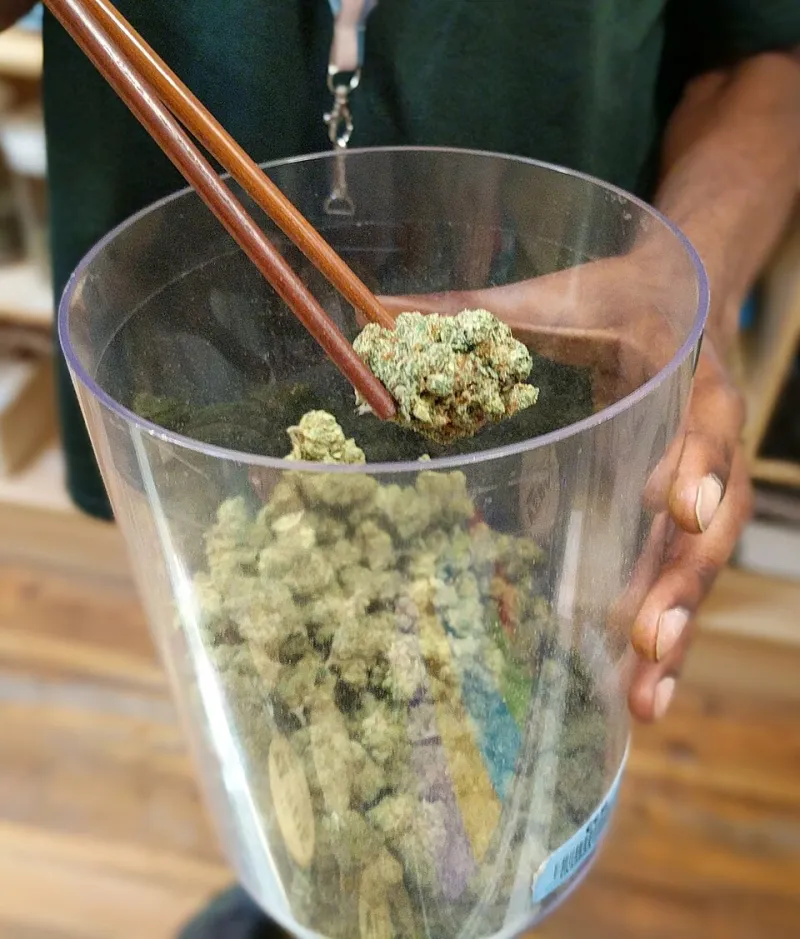
Walk into any dispensary from Portland to Portland and you'll see the same word on every jar: bud. Not flower, technically — the label might say that too. But when a budtender leans over the counter and asks what you're looking for, nobody says "cannabis inflorescence." They say bud.
It's a funny thing when you think about it. Cannabis has accumulated more nicknames than almost any plant on Earth — over a thousand by some linguists' counts — and nearly all of them have been retired, demonized, or regulated into oblivion. Bud just keeps going. It's the last word standing from a century of code-switching, and the reason it survived tells you something about where this culture came from and where it's headed.
When the Word Had to Hide
Every slang term cannabis ever picked up was born out of necessity. When a plant is illegal, its users need a language that doesn't ring alarm bells. In the 1910s and '20s, that meant borrowed Spanish — marihuana drifted north with Mexican laborers — and borrowed jazz. Musicians playing late sets in Kansas City or Harlem didn't announce they were stepping out for cannabis. They were going to get some reefer, or catch a viper's ball. Louis Armstrong sang about it. Cab Calloway's dictionaries of jive were full of it.
Then the 1930s hit, and the code words became weapons. Harry Anslinger's prohibition campaign combed newspapers for exactly those terms — reefer, loco weed, killer weed — and splashed them across lurid headlines about madness and mayhem. The slang that once protected smokers got turned against them. Every time a paper shouted REEFER MADNESS, the word itself became evidence in the case against the plant.
That's the pattern worth noticing: the terms that got the loudest, most moralistic press are the ones that aged worst. Reefer now sounds like your grandpa's black-and-white PSA. Dope became a catch-all for hard drugs nobody wanted to be associated with. Even marijuana, the word that dominated a century of law enforcement, has fallen out of favor — the term arrived with the Mexican Revolution era, got welded to decades of racist enforcement, and today many in the industry quietly prefer the Latin-rooted "cannabis" on packaging and in state statutes.
The Friend Survives
So why did bud make it out alive?
Start with the word itself. Before it ever meant cannabis, bud meant something gentle: the first swell of growth on a branch in early spring, the promise of a flower before it opens. Gardeners bud their roses. Kids learn the word in grade school. There's no underworld in it, no panic, no headline history. When smugglers and smokers in the '60s and '70s needed a term that wouldn't make a cop's ear prick up, "a bud" sounded like a friend's name or a springtime walk.
That plausible deniability mattered, but the word had a second superpower: warmth. In an era when the community was criminalized, cannabis users leaned hard on friendship language — buddies, buds, the circle you trusted enough to share with. Some etymologists argue the two meanings fed each other, that calling your stash "bud" and your people "buds" were two branches of the same root. Whether or not the pun was intentional, the overlap made the word feel like home. You didn't buy bud from a dealer; you got bud from a friend.
And then, almost overnight, the risk evaporated. State after state went medical, then recreational, and the industry needed a word that was accurate, friendly, and clean enough to print on a receipt. "Bud" cleared every bar. It was already the people's term — no rebrand required, no baggage to shake. The word that survived prohibition by hiding in plain sight was suddenly the perfect word for the front window.
From Code Word to Category
Look at a modern dispensary menu and you can watch a century of slang get sorted. "Cannabis" goes on the corporate signage and the lab results. "Flower" shows up in the product taxonomy, clinical and botanical. "Strain" organizes the shelves. And "bud" — the last of the old outlaw vocabulary — sits right there in the middle of it all, fully licensed and tax-stamped.
The industry even built a job title around it. Nobody applied to be a "marijuana technician." Budtender won because it sounds like someone you'd grab a coffee with. That's the whole linguistic story in miniature: the words that lasted are the ones that made the plant feel social instead of scary.
There's a lesson in the survivors, too. The cannabis lexicon is basically a fossil record of American attitudes — every panic, every crackdown, every subculture that adopted the plant left a word behind, and most of those words died with the era that feared them. Bud outlived them all not because it was clever, but because it was kind. It never promised a high or hinted at a crime. It just pointed at the pretty part of the plant and smiled.
A hundred years from now, when the menus are holograms and the flower is grown on orbiting farms or whatever, somebody will still call it bud. The friendliest word in the room always wins.